


1 Competition Overview
1.1 Name
【BRICS2025-ST-146】Architectural Engineering Drawing Application
1.2 Purpose
Architectural engineering drawing is a core link in transforming architectural design concepts, structural logic, and construction requirements into a “visual technical language.” It runs through the entire life cycle of a project, serving as both the “carrier” of design schemes and the “basis” for construction, acceptance, and operation. Its systems, tools, and applications must be implemented hierarchically according to project needs. The Architectural Engineering Drawing Skills Competition will focus on advanced technologies, comprehensive capabilities, and innovative thinking to build a closed-loop growth platform integrating “learning, practice, competition, and application” for participants.
1.3.1 Age Requirement
Participants must be over 16 years old and under 22 years old, with no gender restrictions.
1.3.2 Team Composition
Each team consists of 5 members: 2 competitors, 1 translator, 1 coach, and 1 team leader.
2.1 Competition Tasks
The competition includes 10 tasks, detailed as follows:
Task 1: Architectural Floor Plan Drawing
Read architectural floor plans and related drawing data, identify and avoid design errors, defects, and omissions in drawings and models. Using drawing task documents, design change orders, and template files for floor plan drawing, strictly follow relevant architectural drafting standards, and use CAD software to complete the architectural floor plan.
Task 2: Architectural Elevation Drawing
Read architectural elevation drawings and related data, identify and avoid design errors, defects, and omissions. Using task documents, design change orders, and templates, adhere to architectural drafting standards, and use CAD software to complete the elevation drawing.
Task 3: Architectural Section Drawing
Read architectural section drawings and related data, identify and avoid design errors, defects, and omissions. Using task documents, design change orders, and templates, adhere to architectural drafting standards, and use CAD software to complete the section drawing.
Task 4: Architectural Detail Drawing
Read architectural detail drawings and related data, identify and avoid design errors, defects, and omissions. Using task documents, design change orders, and templates, adhere to architectural drafting standards, and use CAD software to complete the detail drawing.
Task 5: Column Reinforcement Drawing
Read column structural plans and related data, identify and avoid design errors, defects, and omissions. Using task documents, design change orders, and templates, adhere to structural drafting standards, and use CAD software to complete the column reinforcement drawing.
Task 6: Shear Wall Reinforcement Drawing
Read shear wall structural plans and related data, identify and avoid design errors, defects, and omissions. Using task documents, design change orders, and templates, adhere to structural drafting standards, and use CAD software to complete the shear wall reinforcement drawing.
Task 7: Beam Reinforcement Drawing
Read beam structural plans and related data, identify and avoid design errors, defects, and omissions. Using task documents, design change orders, and templates, adhere to structural drafting standards, and use CAD software to complete the beam reinforcement drawing.
Task 8: Slab Reinforcement Drawing
Read slab structural plans and related data, identify and avoid design errors, defects, and omissions. Using task documents, design change orders, and templates, adhere to structural drafting standards, and use CAD software to complete the slab reinforcement drawing.
Task 9: Staircase Reinforcement Drawing
Read staircase structural plans and related data, identify and avoid design errors, defects, and omissions. Using task documents, design change orders, and templates, adhere to structural drafting standards, and use CAD software to complete the staircase reinforcement drawing.
Task 10: Foundation Reinforcement Drawing
Read foundation structural plans and related data, identify and avoid design errors, defects, and omissions. Using task documents, design change orders, and templates, adhere to structural drafting standards, and use CAD software to complete the foundation reinforcement drawing.
2.2 Score Weight Distribution
The score weight of each task module is shown in Table 1.
Table 1 Score Weight Distribution of Competition Tasks
2.3 Competition Duration
The duration of each task module is shown in Table 2.
Table 2 Duration of Competition Tasks
Task No. | Task Name | Duration (min) |
Task 1 | Architectural Floor Plan Drawing | 90 |
Task 2 | Architectural Elevation Drawing |
Table 2 (continued)
Task No. | Task Name | Duration (min) |
Task 3 | Architectural Section Drawing |
|
Architectural Detail Drawing | ||
Task 5 | Column Reinforcement Drawing | 90 |
Task 6 | Shear Wall Reinforcement Drawing | |
Task 7 | Beam Reinforcement Drawing | |
Task 8 | Slab Reinforcement Drawing | |
Task 9 | Staircase Reinforcement Drawing | |
Task 10 | Foundation Reinforcement Drawing | |
Total |
| 180 |
3.1 Evaluation Principles
3.1.1 Comprehensive Principle
The event expert group and referee team shall be responsible for evaluating competition results in accordance with the principles of “fairness, impartiality, transparency, scientificity, and innovation.” Participants will be comprehensively evaluated in aspects including design, equipment operation, and safe production.
3.1.2 Module Independence Principle
To ensure fair, accurate, and objective assessment, each module in the competition must be conducted and evaluated independently. The performance or results of one module must not interfere with the conditions, execution, or evaluation of subsequent modules. This principle ensures:
Thus, each module shall:
Evaluations must assess task-specific abilities demonstrated within each module based on predefined technical standards.
3.2 Distribution of Evaluation and Measurement Scores
The distribution of subjective (evaluation) and objective (measurement) scores is shown in Table 3:
Table 3 Distribution of Evaluation and Measurement Scores
Task No. | Task Name | Evaluation Score | Measurement Score | Total |
1 | Architectural Floor Plan Drawing | 3.6 | 8.4 | 12 |
Table 3 (continued)
Task No. | Task Name | Evaluation Score | Measurement Score | Total |
2 | Architectural Elevation Drawing | 3 | 7 | 10 |
3 | Architectural Section Drawing | 3 | 7 | 10 |
4 | Architectural Detail Drawing | 2.4 | 5.6 | 8 |
5 | Column Reinforcement Drawing | 3.6 | 8.4 | 12 |
6 | Shear Wall Reinforcement Drawing | 2.4 | 5.6 | 8 |
7 | Beam Reinforcement Drawing | 3 | 7 | 10 |
8 | Slab Reinforcement Drawing | 2.4 | 5.6 | 8 |
9 | Staircase Reinforcement Drawing | 3 | 7 | 10 |
10 | Foundation Reinforcement Drawing | 3.6 | 8.4 | 12 |
Total |
| 100 | ||
3.3 Evaluation Scores
Scoring Method: A panel of 4 referees will be formed, including one rotating referee (who scores other teams but not their own). Three referees independently assign weighted scores, and the average weighted score is calculated as the final result. Referees’ score differences must be ≤1 point; if exceeding 1 point, they must justify their scores, and a consensus will be reached under the chief referee’s supervision.
Table 4 Weighted Evaluation Score Criteria
Weighted Score | Requirements Description |
0 | Below industry standards in all aspects; “no attempt” or unacceptable. |
1 | Meets industry standards. |
2 | Meets industry standards and exceeds them in some aspects. |
3 | Achieves industry-expected excellence. |
3.4 Measurement Scores
Scoring Method: Scoring groups will be established by task, with each group consisting of 4 referees. All referees in a group will discuss collectively and agree on a single final score for the participant’s performance in that task. Examples of measurement scoring are shown in Table 5.
Table 5 Examples of Measurement Scoring
Type | Example |
Full or zero points | Completeness of a drawing (1 point): Only 1 or 0 points are awarded. |
Deductions from full marks | A drawing with 10 critical dimensions (2 points total): 0.2 points deducted per non-compliant dimension (e.g., 4 deductions = 2 – 0.8 = 1.2 points). |
Additions from zero | 5 critical dimensions (5 points total): 1 point awarded per compliant dimension (e.g., 2 compliant = 2 points). |
3.5 Evaluation Process
3.5.1 Result Scoring
Submitted works will be scored according to predefined technical standards.
3.5.2 Penalty Deductions
Participants will face deductions for the following violations:
3.5.3 Sampling Review
To ensure accuracy, the supervision team will review ≥30% of scores. Discrepancies will be reported in writing to the expert team leader, who will correct scores and confirm with a signature.
3.6 Score Tabulation
Each scoring group will evaluate their assigned modules independently, combining process scoring with post-event result scoring. Scores for work completed by participants must be finalized on the same day. USB data storage devices must not be modified after saving and must be sealed and submitted to the chief referee for safekeeping. Evaluation and measurement score sheets must be signed by all participating referees before submission to the expert team leader for safekeeping.
3.7 Ranking
Scores will be aggregated for ranking. In case of tied total scores, Task 1 scores will be used as the tiebreaker, followed by Tasks 2 and 3 in sequence.
3.8 Result Announcement
Results will be announced at the closing ceremony.
3.9 Awards
3.9.1 Certificates
Participating teams will receive award certificates issued by the competition organizers.
3.9.2 Gold, Silver, Bronze Medals, and Merit Awards
The competition will award gold, silver, bronze medals, and merit awards. Teams from all countries will be ranked collectively. The top 6 participants in each event will receive gold, silver, or bronze medals and certificates; participants ranked 7th to 9th will receive merit awards and certificate
3.9.3 Other Awards
Certificates will be issued to expert group members and referees. Organizations making outstanding contributions to the competition will receive the “Outstanding Contribution Award.” National organizing units that actively organize participation, conduct pre-competition training, and have no rule violations will receive the “Excellent Organization Award.”
4 Technical Platform
4.1 Platform for Architectural Engineering Drawing Event
4.1.1 Computer Platform
4.1.1.1 Server/Master Computer:
System: Microsoft Windows 10 64-bit (<50 users) & Microsoft Windows Server Standard 2016 64- (>50 users)
Processor: Intel Core i7-11700 or AMD Ryzen 7 3800X or higher
Memory:≥4GB frequency ≥2400MHz (<50 users); ≥8GB frequency ≥2400MHz (>50 users)
Hard: ≥256GB NVMe protocol solid state drive, read/write speed ≥3000MB/s
Display: ≥19 inches (any ratio), resolution ≥1920×1080
Other: Matching keyboard and mouse, USB, HDMI interface
4.1.1.2 Participant Computers:
System: Microsoft Windows 10 64-bit
Processor: Intel Core i7-11700 or AMD Ryzen 73800X or higher
Memory: ≥8GB with frequency ≥2400MHz
Graphics card: Nvidia GeForce RTX 2060 or AMD Radeon RX 6600 or higher
Hard drive: ≥256GB SSD with NVMe protocol, read/write speed ≥300MB/s
Monitor: ≥24 inches (any aspect ratio), resolution ≥1920×1080
Other: Matching keyboard mouse, USB, HDMI, DP interfaces
4.1.2 Software Platform
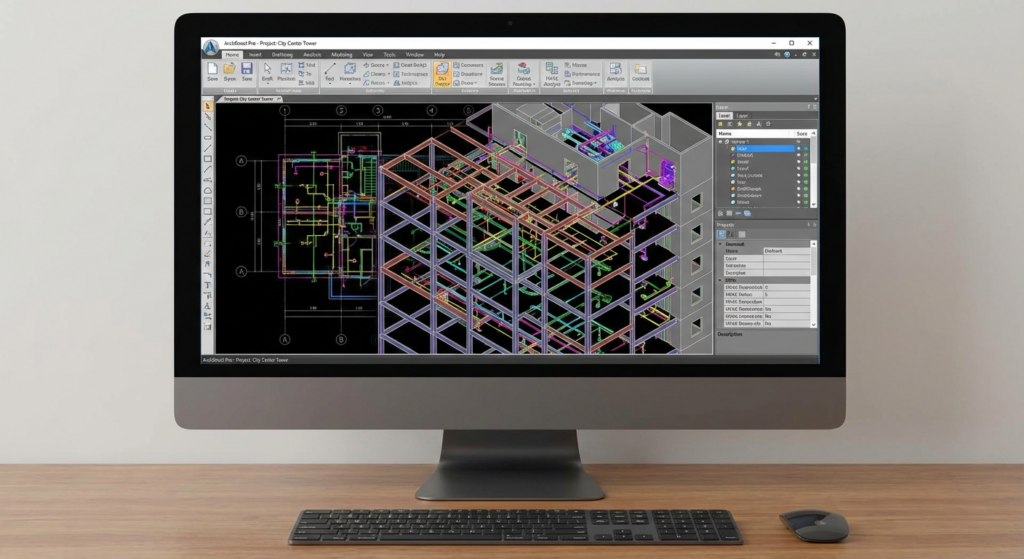
Software version: ZWCAD Mechanical Education Edition 2025.
Figure1 Software interface
4.1.3 Software Features
Standard Parts Library: Built-in with 56 major categories and nearly 300,000 standard parts catalogs, covering 12 professional fields such as machinery, automotive, and mold design. Supports parametric modification and custom expansion.
Intelligent Drawing Tools: Provides an intelligent annotation system that automatically completes 80% of annotation work and synchronizes text data updates. Includes professional drawing tools for process grooves and tooling grooves to shorten design cycles.
4.2 Report making generate format
Unified in PDF format.
5 Safety Regulations
5.1 Safety Training
The safety officer will organize safety training for all referees, staff, and participants. Only those who pass the training assessment are allowed to participate.
5.2 Safety Facilities
The competition venue must meet the following safety requirements:
5.3 Medical Equipment and Measures
Medical personnel, first-aid staff, emergency facilities, and response protocols must be available on-site.

Digital Innovation – international competition 2026
©2026. All Rights Reserved.