


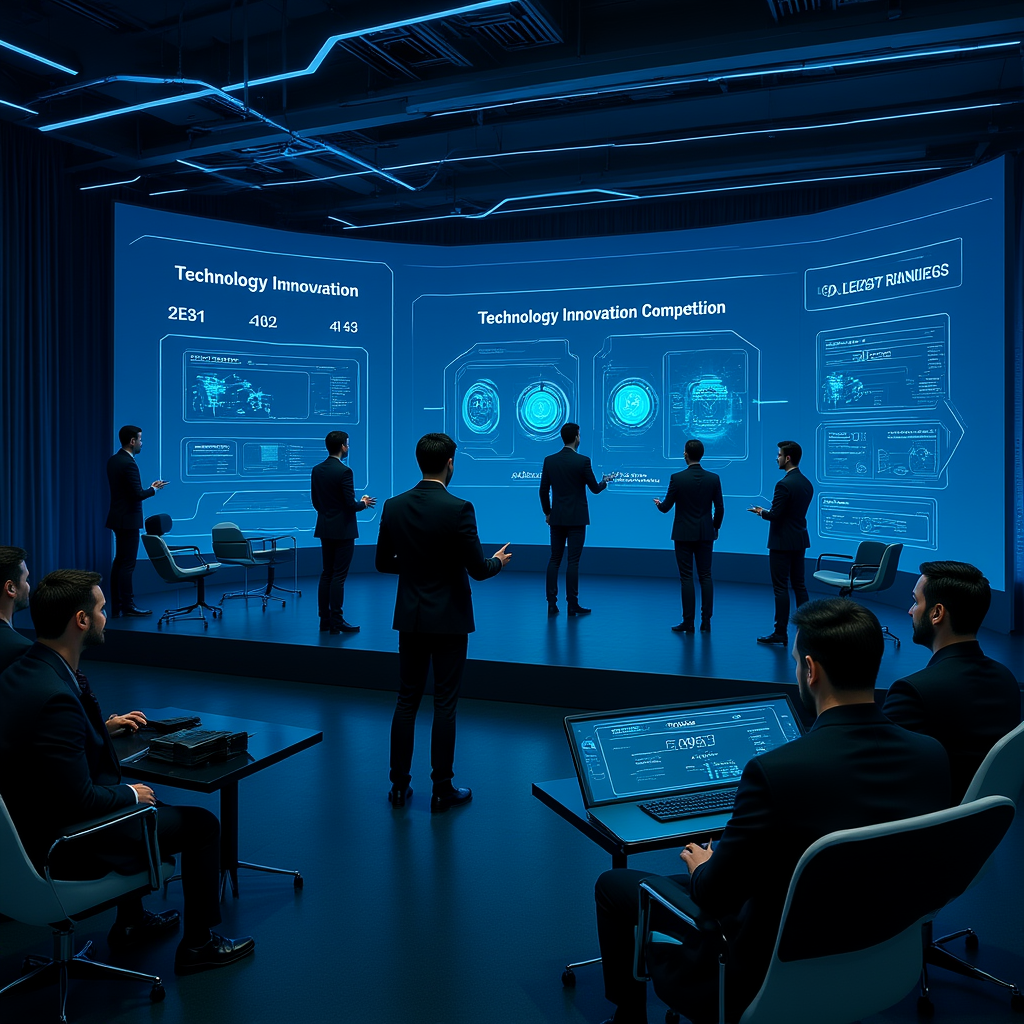
1.1 Competition Introduction
The Technology Innovation Competition, themed “Technological Innovation Leads the New Industrial Development of BRICS Countries”, sets up ten tracks: Advanced Manufacturing, Digital Healthcare, Green Energy, Artificial Intelligence, Virtual Simulation, Digital Agriculture, Future Technologies, Air Space and Communication Technologies, End -end Solution for Government and Public Management Platforms, and Competence and Employee Development.
1.2 Objectives
The Technology Innovation Competition encourages innovative exploration around industry pain points, promotes cross disciplinary collaboration and technological integration, encourages participants to integrate multidisciplinary knowledge, break down technological barriers, and develop more innovative comprehensive solutions; Screen high-quality technological achievements for the industry, explore innovative projects with commercial potential through the competition evaluation mechanism, and help technology quickly meet industry needs. Competitions can hone participants’ problem-solving skills, innovative thinking, and teamwork abilities, accumulate practical experience, and lay the foundation for career development; Assist the industry in transforming towards high-end and intelligent industries, and promote the sustainable development of the entire industry.
1.3.1 Age Requirement
Over 18 years old, regardless of gender.
1.3.2 Team Composition
Each team consists of 2-5 members
2.1 Competition Requirements
(1) Each team shall design their own entry project in combination with the track direction;
(2) The submitted project must be original and not have won awards in other international competitions. In case of plagiarism, the relevant entries will be scored zero.
2.2 Tracks
No. | Track Name | Track Introduction |
1 | Advanced Manufacturing | By utilizing new technologies, equipment, materials, processes, procedures, and production organization methods, we can safely, efficiently, and cleanly process and manufacture labor objects to produce high-quality and high-performance industrial products that meet the needs of society. Focusing on Digital twins, Micro nano manufacturing, Additive manufacturing, Industrial design, and industrial robots, etc |
2 | Digital healthcare | Centered around intelligent, personalized, and comprehensive services.Based on digital healthcare, provide innovative solutions to promote the sharing of medical data, deep integration of medical resources, and inter-connectivity. |
3 | Green energy | Promoting green and low-carbon development of the economy and society to help achieve high-quality development, with a focus on industrial green transformation and upgrading, carbon neutrality, new energy technologies, and smart grid solutions, etc. |
4 | Artificial Intelligence | Using artificial intelligence technology to solve practical problems, promoting innovation and application of artificial intelligence technology, including deep learning, natural language processing, reinforcement learning, content generation using artificial intelligence technology, and AI creative applications, etc. |
5 | Virtual Simulation | Focus on industrial design simulation, digitalization of engineering scenarios, enterprise operation simulation, augmented reality and virtual reality, as well as innovative applications in the metaverse. |
6 | Digital Agriculture | A modern agriculture that focuses on information as a factor of agricultural production,utilizes modern information technology for visual representation, digital design, and information management of agricultural objects, environments, and entire processes.The key focus includes precision agriculture technology and equipment, agricultural IoT systems, agricultural product processing and logistics, and agricultural product quality and safety traceability systems. |
7 | Future Technology | Including future technological fields not covered in the aforementioned track,targeting cutting-edge, revolutionary, and disruptive technological innovations in the future of BRICS countries,condensing the characteristics based on interdisciplinary and cross-border knowledge integration, and focusing on examining the forward-looking thinking and original innovation capabilities of future technologies.。 |
8 | Air Space and Communication Technologies | Including but not limited to: Geographic Information Systems, Satellite control/Communication technology, UAV, (4-5G) Wireless communication, Quantum communication, Wireless Technology, Internet of Things, etc. |
9 | End -end Solution for Government and Public Management Platforms | Including but not limited to:National and Municipal Technology Platforms;Enterprise Technology Platforms;International Technology Platforms;Intelligent Decision-Making Systems;Providing digital services and service ecosystems for citizens, etc. |
10 | Competence and Employee Development | Including but not limited to:Artificial Intelligence、National training programs in key technologies and other fields;Project leaders/teams/solutions in the fields of block chain, artificial intelligence, IoT, digital twins, etc |
2.3 Content Requirements
Specific Content | Outcome Form | Assessment Points |
Project Introduction | Project Specification | Project technical plan; |
Technical Proof | Patents, Papers | Clearly propose the key core technologies or future technologies to be solved, provide analysis and evaluation of relevant domestic and foreign research status, and give 1-2 of the most influential patents and papers in the past three years as proof. |
Defense PPT | PPT File | Information collection and planning stage; |
Project Video | Video File | Project development process; |
2.4 Project Submission Instructions
(1) The project introduction format is a PDF electronic document, not exceeding 8 pages.
(2) The technical certification format is a PDF electronic document.
(3) The defense PPT should be a PowerPoint electronic document, not exceeding 10 pages;
(4) The video file should be in MP4 format, with a file size not exceeding 100MB, a video duration not exceeding 2 minutes, and a resolution of 720 × 576 (4:3) or 1024 × 576 (16:9);
3 Evaluation Criteria
3.1 Evaluation Principle
3.1.1 Comprehensive Principle
The competition evaluation team evaluates the contestants in a comprehensive manner in accordance with the principles of “fairness, impartiality, openness, science, and innovation”.
3.2 Evaluation Score Distribution
3.2.1 Implementation Section (40 points)
Realisation | Max. Punkte | Instructions | Expand |
Functionality | 8 | was the planned goal achieved? | relation idea and realisation |
Usability | 6 | How handy is the result? | user friendly, self-explanatory |
Quality | 8 | Relation to other solutions | high grad of innovation, good performance |
Sustainability | 6 | Balancing economic development, environmental protection, and social equity | multi functionality, enviroment friendly, re-used materials |
Costs | 6 | How costly is the project in relation to the outcome? | Material, Produktiontime |
Technical effort | 6 | how big is the effort of implementation in realation to other solutions? | competitive to comparable solutions |
3.2.2 Innovation Section (40 points)
Concept development | Max. Punkte | Instructions | Expand |
Requirements analysis | 5 | How clearly were the requirements presented? | conceptional analysis |
Research | 8 | How complex was the research? | different appoaches were analysed |
Development | 8 | Is the development process shown clearly? | quality of documentation |
Creative potential | 8 | Potential in relation to other solutions, grade of innovation | independent development of ideas |
Conceptional realisation | 6 | How far has the idea/the concept worked out | easy to realize |
Transformation | 5 | Is the concept transferable to another purpose? | multi usability, overarching concept |
3.2.3 Presentation section (20 points)
Presentation | Max. Punkte | Instructions | Expand |
statement | 6 | How clear was the presentation? | qualitiy of performance |
traceability | 5 | How comprehensibile is the presentation? | different steps clearly explained |
layout | 5 | design quality of the presentation | layout in relation to content |
model | 4 | Whether there is a prototype or software | Prototype or software demonstration |
3.3 Evaluation Process
3.3.1 Result Scoring
Evaluate and score the competition results submitted by the contestants in accordance with the competition evaluation criteria.
3.3.2 Sampling Recheck
To ensure the accuracy of score statistics, the supervision team rechecks the scores; the sampling coverage rate shall not be less than 30%. The supervision team shall promptly inform the expert team leader of the errors found in the recheck in writing, and the expert team leader shall correct the scores and sign for confirmation.
3.4 Ranking
Scores are aggregated and ranked. If the total scores are the same, compare the scores of Task 1, and the one with the higher score ranks higher. If the total scores are the same, the rankings are determined by the scores of the implementation section, innovation section, and presentation section in sequence.
3.5 Announcement of Results
The competition results will be announced at the closing ceremony.
3.6 Awards Setting
3.6.1 Certificates
Participating teams can obtain award certificates issued by the relevant organizers of the competition.
3.6.2 Gold, Silver, Bronze Medals and Merit Awards
First prize (gold medal) accounts for 15%; second prize (silver medal) accounts for 25%; third prize (bronze medal) accounts for 35%; the above awards will be awarded with medals and certificates, and other participating teams will be awarded merit certificates.
3.6.3 Other Awards
Expert team members participating in the adjudication will be awarded expert certificates.
4 Competition Safety
4.1 Safety Facilities
The competition venue is equipped with necessary safety isolation measures and safety passages, complete with fire-fighting and other emergency treatment facilities. Safety operation procedures are posted in prominent positions, and safety evacuation signs are set up.
4.2 Medical Equipment and Measures
The competition venue must be equipped with corresponding medical personnel and first-aid personnel, as well as corresponding first-aid facilities and plans.

Digital Innovation – international competition 2026
©2026. All Rights Reserved.