


1.1 Name
【BRICS2025-ST-116】UAV Flight Application Technology
1.2 Purpose
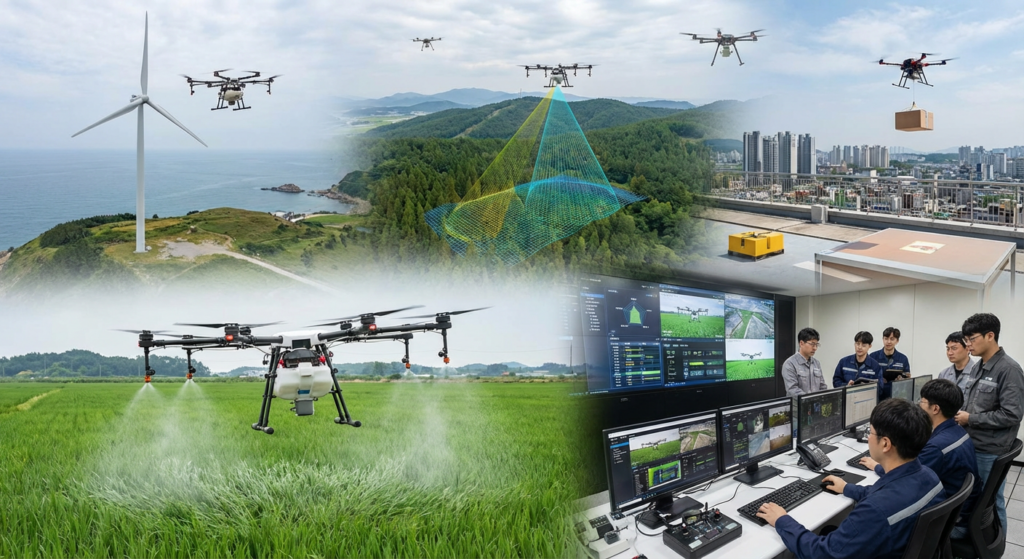
The core value of UAV flight application technology lies in “using technology to break through human limits” – it not only improves operational efficiency and reduces costs, but also enables humans to enter “dangerous, remote, and complex” environments (such as high altitudes, disaster areas, and deep seas) to carry out work. In the future, UAV technology will be deeply integrated into the processes of agricultural precision, industrial unmannedization, and urban intelligence, becoming an important infrastructure of the digital economy. The UAV flight application technology skill competition will be designed around advanced technology, comprehensive capabilities, and innovative thinking to build a closed-loop growth platform of “learning, practicing, competing, and applying” for students.
1.3.1 Age Requirement
Participants must be over 16 years old and under 22 years old, with no gender restrictions.
1.3.2 Team Composition
Each team consists of 5 members: 2 competitors, 1 translator, 1 coach, and 1 team leader.
2.1 Competition Tasks
The competition content is divided into 3 tasks, as follows:
Task 1: UAV Eight-Directional Hovering Flight Control (1.5 hours)
Use the UAV virtual simulation system to complete eight-directional hovering, spinning, ascending, and descending; mainly assess the players’ UAV eight-directional hovering control ability in attitude mode, and prepare a PPT report as required by Task 3.
Task 2: UAV Horizontal Figure-Eight Flight Control (1.5 hours)
Use the UAV virtual simulation system to complete the UAV spinning figure-eight route flight; mainly assess the players’ control ability in figure-eight flight and hovering, and complete the PPT report as required by Task 3.
Task 3: Report Presentation (15 minutes)
Players present and defend the PPT reports completed in Task 1 and Task 2.
2.2 Score Weight Distribution
The score weight of each task module is shown in Table 1.
Task | Name | Score Proportion (%) |
Task 1 | UAV Eight-Directional Hovering Flight Control | 40 |
Task 2 | UAV Horizontal Figure-Eight Flight Control | 30 |
Task 3 | Report Presentation | 30 |
Total |
| 100 |
2.3 Competition Duration
The duration of each task module is shown in Table 2.
Task | Name | Competition Duration (min) |
Task 1 | UAV Eight-Directional Hovering Flight Control | 90 |
Task 2 | UAV Horizontal Figure-Eight Flight Control | 90 |
Task 3 | Report Presentation | 15 |
Total |
| 195 |
3.1 Evaluation Principles
3.1.1 Comprehensive Principle
The expert group and referee team of the event will be responsible for evaluating the competition results in accordance with the principles of “fairness, justice, openness, science, and innovation”. Conduct a comprehensive evaluation of the players in terms of design, equipment operation, and civilized production.
3.1.2 Module Independence Principle
To ensure fair, accurate, and objective assessment, each module in the competition must be conducted and evaluated independently. The performance or results of one module must not interfere with the conditions, execution, or evaluation of subsequent modules. This principle ensures:
Thus, each module shall:
Evaluations must assess task-specific abilities demonstrated within each module based on predefined technical standards.
3.2 Distribution of Evaluation and Measurement Scores
The distribution of subjective (evaluation) and objective (measurement) scores is shown in Table 3:
Task | Name | Evaluation Score | Measurement Score | Total |
Task 1 | UAV Eight-Directional Hovering Flight Control | 0 | 40 | 40 |
Task 2 | UAV Horizontal Figure-Eight Flight Control | 0 | 30 | 30 |
Task 3 | Report Presentation | 15 | 15 | 30 |
Total |
| 30 | 70 | 100 |
3.3 Evaluation Scores
Evaluation score scoring method: 4 referees form a group, one of whom is a rotating referee, who scores the players in the same group and cannot score their own players. 3 referees score independently, give weight scores for a player’s assessment items, obtain the average weight score, and calculate the actual score. The difference in weight scores between referees can be less than or equal to 1 point. If it exceeds 1 point, the assessment reasons for the player’s assessment items need to be stated, and a reasonable score is given under the deliberation and supervision of the chief referee. The evaluation score weight table is shown in Table 4.
Weight Score | Requirement Description |
0 points | Below industry standards in all aspects, including “no attempt” or unacceptable |
1 point | Meet industry standards |
2 points | Meet industry standards and exceed standards in some aspects |
3 points | Reach the excellent level expected by the industry |
3.4 Measurement Scores
Scoring Method: Scoring groups will be established by task, with each group consisting of 4 referees. All referees in a group will discuss collectively and agree on a single final score for the participant’s performance in that task. Examples of measurement scoring are shown in Table 5.
Type | Example |
Full score or zero score | The integrity of a certain flight action is allocated 1 point, and the player’s score has only two possibilities: either full score or zero score |
Deduction from full score | A flight action has 10 key actions, with a maximum score of 2 points. 0.2 points are deducted for each unmet requirement |
Addition from zero score | A flight action has 5 key actions, with a maximum score of 5 points. 1 point is awarded for each met requirement |
3.5 Evaluation Process
3.5.1 Result Scoring
Submitted works will be scored according to predefined technical standards.
3.5.2 Penalty Deductions
Participants will face deductions for the following violations:
To ensure accuracy, the supervision team will review ≥30% of scores. Discrepancies will be reported in writing to the expert team leader, who will correct scores and confirm with a signature.
3.6 Score Tabulation
Each scoring group will evaluate their assigned modules independently, combining process scoring with post-event result scoring. Scores for work completed by participants must be finalized on the same day. USB data storage devices must not be modified after saving and must be sealed and submitted to the chief referee for safekeeping. Evaluation and measurement score sheets must be signed by all participating referees before submission to the expert team leader for safekeeping.
3.7 Ranking
Scores are summarized and ranked. If the total scores are the same, compare the scores of Task 1, and the one with the higher score ranks first. If the total scores are the same, the ranking is determined by the scores of Task 1, Task 2, and Task 3 in sequence.
3.8 Result Announcement
Results will be announced at the closing ceremony.
3.9 Awards
3.9.1 Certificates
Participating teams will receive award certificates issued by the competition organizers.
3.9.2 Gold, Silver, Bronze Medals, and Merit Awards
The competition sets gold, silver, bronze medals and merit awards. All participating teams from various countries are ranked uniformly. For the players who rank in the top 6 in each competition event, gold, silver, bronze medals and certificates will be awarded accordingly; for the players who rank outside the top 6 but in the top 9, merit award medals and certificates will be awarded.
Certificates will be issued to expert group members and referees. Organizations making outstanding contributions to the competition will receive the “Outstanding Contribution Award.” National organizing units that actively organize participation, conduct pre-competition training, and have no rule violations will receive the “Excellent Organization Award.”
4 Technical Platform
4.1 UAV Flight Simulation Platform
4.1.1 Platform Introduction
Tian Tu Flight Simulation Software is a UAV simulation flight training software for individual and enterprise users, aiming to provide high-quality, comprehensive, and systematic UAV simulation flight teaching and training. Relying on refined modeling and flight control simulation technology, it simulates UAV flight training tasks in real flight scenarios to help you better understand the operation and use rules of UAVs.
By using Tian Tu Flight Simulation Software, it has the following advantages:
(c) Flexible selection: Provide flight training subjects of different difficulty levels and licenses according to different user needs, and support the flight of multiple UAV types;
4.1.2 Platform Functions
Tian Tu Flight Simulation Software supports 18 training and examination subjects for civil unmanned aircraft controller licenses, including: competition figure-eight, figure-eight waypoint 1 circle, figure-eight waypoint 2/4 circles, figure-eight waypoint 1/2 circle and new figure-eight waypoint 1/4 circle, figure-eight waypoint 3/4 circle, horizontal figure-eight and horizontal figure-eight test 70 points, figure-eight simulation test, horizontal figure-eight test, horizontal figure-eight solo flight and fixed-height spinning 70 points, fixed-height spinning, arbitrary point hovering figure-eight waypoint, eight-direction hovering, four-direction hovering, arbitrary point hovering four-direction.
5 Event Safety
5.1 Safety Training
The safety officer organizes all referees, staff, and players to conduct safety training, and they can participate in the competition only after passing the training assessment.
5.2 Safety Facilities
The safety facilities requirements for the competition venue are as follows:
5.3 Medical Equipment and Measures
The venue must be equipped with corresponding medical personnel and first-aid personnel, as well as corresponding first-aid facilities and plans.
5.3 Medical Equipment and Measures
Medical personnel, first-aid staff, emergency facilities, and response protocols must be available on-site.

Digital Innovation – international competition 2026
©2026. All Rights Reserved.